Portfolio
Worldwide Vets Blog
〰️
Worldwide Vets Blog 〰️

There is a persistent and dangerous myth at the heart of wildlife trafficking that continues to drive the illegal killing of some of the world’s most iconic species. From rhino horn being claimed as a miracle cure to elephant ivory symbolising status and wealth, these narratives are not only false, but devastating in their consequences. To truly address wildlife trafficking, we need to confront the myths head-on and understand the reality behind them.

Let’s start with rhino horn. Despite widespread belief in parts of the world, rhino horn has no proven medicinal value. Scientifically, it is composed primarily of keratin; the same protein that makes up human hair and nails. There is no credible evidence to support claims that it can cure cancer, improve virility, or detoxify the body. Yet, the demand persists, largely fueled by tradition, misinformation, and, in some cases, deliberate marketing by those profiting from its sale. The result? Rhinos are poached at alarming rates, often left to die in prolonged suffering for something that holds no real medical benefit.

Elephant ivory follows a slightly different narrative but is equally harmful. Ivory has long been associated with luxury, craftsmanship, and status. Historically carved into ornaments, jewellery, and art pieces, its value lies in its aesthetic and symbolic appeal rather than any functional use. However, this demand comes at an extraordinary cost. Elephants are highly intelligent, social animals with complex family structures. When one is killed for its tusks, it doesn’t just impact the individual; it disrupts entire herds, leaving lasting behavioural and ecological consequences.
What’s often overlooked in these discussions is the broader ecosystem impact. Both rhinos and elephants are considered keystone species, meaning their presence plays a critical role in maintaining the balance of their environments. Elephants, for example, help shape landscapes by dispersing seeds and creating water access points used by other animals. Rhinos contribute to grassland management, supporting biodiversity. Removing them doesn’t just reduce population numbers. It alters entire ecosystems. There is a fascinating TED Talk regarding the impact herbivores, including elephants, have on their surrounding ecosystems. You can watch in the link below for yourself. How to green the world's deserts and reverse climate change | Allan Savory
Another uncomfortable truth is that wildlife trafficking is not just about animals. It’s a complex, global criminal enterprise. It is often linked to organised crime networks, corruption, and even funding for armed conflict. Local communities, who are frequently portrayed as perpetrators, are often caught in cycles of poverty with limited alternatives. In many cases, the real drivers sit much further up the chain: international buyers, collectors, and markets that continue to create demand.
So where does that leave us? Education is a critical starting point. Dispelling myths around rhino horn and ivory is essential in reducing demand. Conservation efforts must also focus on supporting local communities, providing sustainable livelihoods, and strengthening law enforcement. But perhaps most importantly, there needs to be a cultural shift. One that moves away from viewing wildlife products as symbols of status or solutions to health, and instead recognises their true cost on the world around us.
Ultimately, wildlife trafficking persists because of what people believe. Change the belief, and you begin to change the outcome.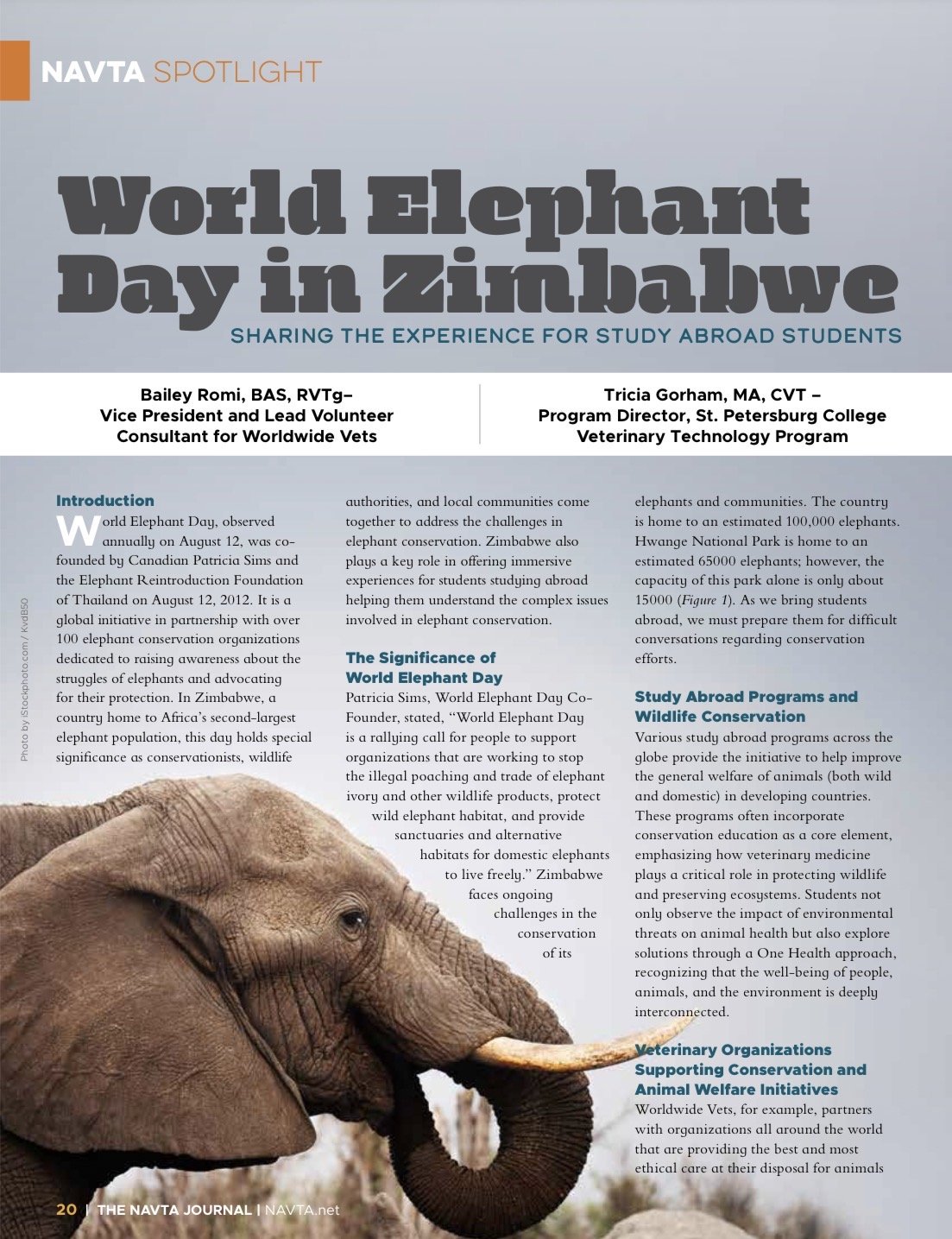
Published in the National Association of Veterinary Technicians in America Journal (NAVTA) in 2025.
National Association of Veterinary Technicians in America (NAVTA)
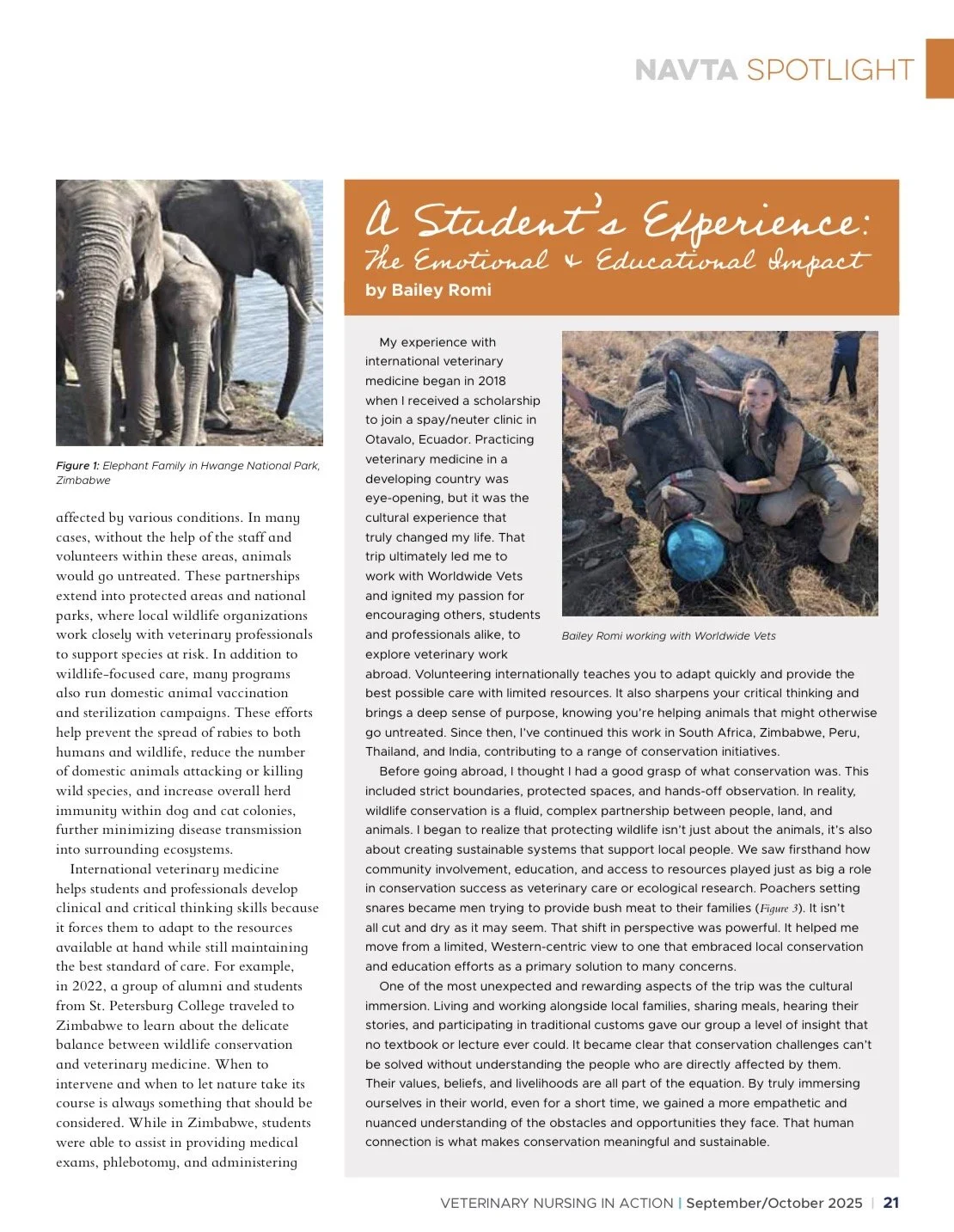
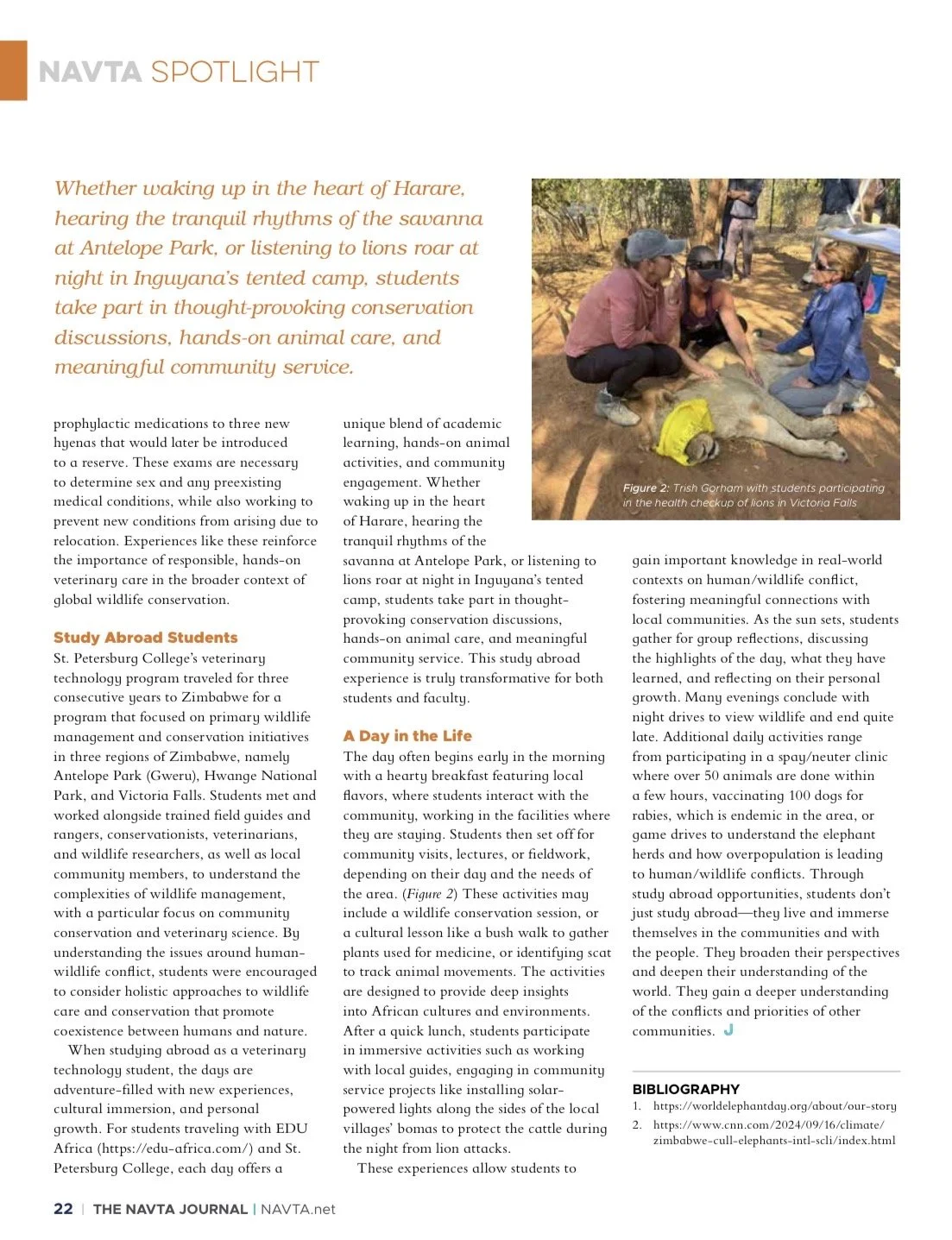


Published in Archaeopteryx Veterinaris (AV) in 2023.
Archaeopteryx Veterinaris (AV) | Archaeopteryx (archaeopteryx-online.com)

Instagram Topic: Hyena Penises
It is next to impossible to tell male and female hyenas apart because they have a pretty incredible evolutionary trait.
Female hyenas have fully functional pseudo-penises.
Females are normally larger and more dominant than the males in their clan, but this isn't a good give-away. The only way to definitively tell their sex is to dart the hyena, palpate their genitals for testicles, and draw blood for hormonal analysis.
Their penis can urinate, mount other males/females for dominance, and give birth.
In order for females to mate, their penis expands and folds upward (think rolling up a shirt-sleeve) to accept the male's penis. To give birth, the female has to push pups almost at a right-angle to deliver through their dilated penis.
Talk about some big 🍆 energy!
#wildlifeconservation #vetabroad #africanconservation #volunteerabroad #volunteer #vetvolunteer #zimbabwe #zimbabwevolunteering #volunteerafrica #travelabroad #wildlifemanagement #ecotourism #vetmed #conservation #vetnurse #vetstudent #veterinary

A Plea for Help
Rescues are full. Shelters are full. Waitlists are full. They’re full of incredible animals that are perfectly friendly and deserving of a new home. The people who run these places are overworked, underpaid, physically exhausted, and mentally exhausted. I know.
So, I know how it sounds for me to plead with people. Beg for people to see this diamond in the rough because I KNOW there are better dogs in shelters and rescues. I KNOW there are easier dogs that are just as deserving. But I don’t feel I’m giving my guy the justice he deserves if I don’t try my hardest to get him rescued. So here I am. In search of rescue or foster placement with an experienced handler.
Burnie has a sincerely traumatic background. Upon arrival to our shelter nearly three months ago, his paw pads were falling off. Like peeling off in sheets so thick that he COULD NOT WALK. Despite his condition that day, I could pick him up and examine his pads with no issues. Whether this was intentional or not, it’s clear that they were horrifically burned. My assumption is that he was tied out on asphalt for extended periods of time and then dumped on the outskirts of our city.
As he began healing, he became barrier reactive and had significant stranger danger. This was notably heightened due to use of trazodone, which we quickly identified as a trigger and removed him from it.
Over the last several weeks, he has made significant strides with the use of reconcile and a constant routine. He will do just about whatever I ask of him. We had him recently evaluated by a trainer and I fear I inadvertently triggered his poor behavior that day as there was a complete break in his normal routine that I am happy to discuss with anyone interested. He did poorly with the male trainer that day and had issues with my coworker for the rest of the week. The trainer firmly believes, other than being neglected and abandoned, he was trained to be aggressive with strangers. It is not impossible to train that out of him, but it’s work. Work most people aren’t willing to put in.
Here’s the deal. We are running out of options and we’re discussing euthanasia. Behavior euthanasia blows. It’s horrible to have to make that call on a perfectly healthy dog that has no problems with your staff, is great with other dogs, and doesn’t mind cats, but is a total jerk wad with new people. We have bonded and I adore him, but I am not in a position where he can come to my home.
This is my last stitch effort for someone to help him. Last night, I sat on the ground with him as he licked my face and snuggled my lap. I cannot give up on him just yet. I’m 100% willing to work with anyone who wants to help him. He needs a home with a woman who is patient, has experience with behavior issues, and is willing to meet him multiple times before committing.
Burnie is the sweetest, most lovable dog when he is comfortable with you. Given his past, I can’t blame him. I do understand his situation isn’t for the faint of heart. If I can’t find the perfect fit, I’ll be with him until the end. I just pray it doesn’t come to that.

You Can Make a Difference
Abandoned. Dumped. Discarded like trash.
These babies were found on the side of a rural road in the rain and covered in some sort of sticky residue.
We may never know where they came from or how they got there. But what we do know is that they are safe.
We are in kitten season. It is supposed to last from spring to early fall. However, in the last few years it has lasted all year long. Our shelter has taken in a grand total of 46 kittens since the beginning of April. 14 of which were either born or picked up within the last 3 days. Because of our loving community, every single one of these kittens have been placed in loving foster homes with their moms (if they had them).
I want to use this post to tell you if you have a cat, get them fixed. I’ve heard a variety of reasons why owners don’t want to and (SPOILER) there is rarely a good reason. The most common excuses are:
“They never get out.”- Accidents happen and if they do escape intact, the likelihood of them coming back pregnant or impregnating another cat is high.
“I don’t want to put my cat under anesthesia.”- Talk to your vet about your concerns. Anesthesia is typically very safe for such a simple procedure that most vets can do with one hand tied behind their back (to be clear, they don’t actually spay and neuter with one hand)
“I love kittens, so I want to have a few litters.”- No. Just no. According to the ASPCA, approximately 530,000 cats and kittens are euthanized each year due to over-crowding or illness in shelters. This is 200,000 MORE than dogs. While shelters in this area only euthanize for severe illness or severe behavioral problems, the facts still stand. Other areas are much more populated than ours and would be faced with difficult decisions. If you love kittens so much, FOSTER for your local shelter.
The benefits of these procedures for your babies are numerous! A spay/neuter procedure decreases or eliminates risks for mammary tumors, testicular cancer, uterine cancer, ovarian cancer, pyometra, marking, roaming, and/or fighting.
Please help us make next year a record low in our kitten population. Choose to spay or neuter.
For more information and shelter statistics, visit: Pet Statistics | Shelter Intake and Surrender | ASPCA.
Rabies: Fact or Fiction?
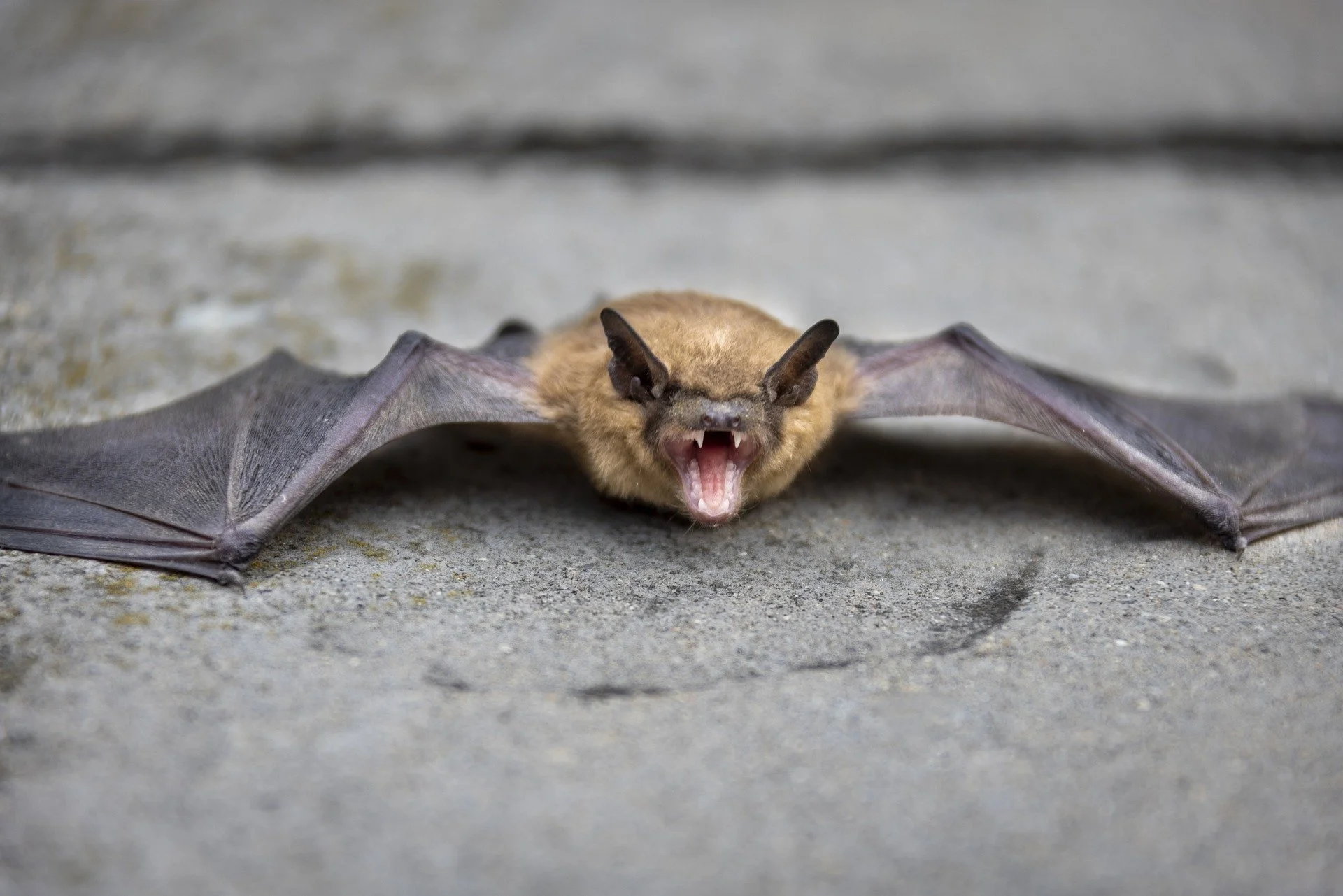
Rabies is a viral disease that is typically exchanged via the saliva of an infected animal to another animal or human. The typical hosts for rabies are wildlife. In the Midwest, these are bats, skunks, and racoons. While rabies is extremely uncommon, there is the potential for non-vaccinated animals to contract and pass the disease to others.
When someone first thinks ‘rabies’, most immediately think of bats. Interestingly, bats are the most predominant host species but less than 1% of the wild bat population have contracted the disease. (4) Further, bats rarely pose a risk in transmission to humans as once they contract the disease, they progressively decline into a paralyzed state. (4) While this may not affect humans much, it can affect house pets.
In 2020, my animal control department was contacted by a pest control specialist who found his personal dog chewing on a deceased bat. The bat was sent for rabies testing and the results came back positive. The dog had recently been given an up-to-date rabies vaccination but had to be quarantined at home for 6 months to monitor any behavior changes. Positive cases were so rare that this was the first one I had ever seen in my time working with animal control. Because the dog was vaccinated, his life was saved.
The virus presents in two different ways. Animals are either extremely aggressive or in a tame state that is unusual for their behavior. General symptoms according to the CDC are difficulty swallowing, drooling, biting at any stimulus, tame behavior that is unusual to the specific animal, or seemingly paralyzed. (3) Additionally, head pressing is a neurological sign that is a worrisome of a neurological disease.
Rabies is extremely preventable. All domesticated animals or livestock are generally required to have annual rabies vaccinations unless the vaccinations are described to last longer than one year. As a general rule, do not handle ill or oddly behaving wildlife unless you are trained and pre-exposure vaccinated. The pre-exposure vaccination is for humans in the veterinary and veterinary related fields who have a higher potential to be exposed to the disease. This vaccination is 1.0 ml and given in three series that at 0 days, 7 days, and 21-28 days. (1)
If one is bitten by any animal, it should be immediately reported to the animal control department or police department for proper record keeping. The owner of the dog is required to provide proof of rabies vaccination at the time of the incident. If there is no proof to be found and/or the animal is not acting normally, the victim should go to the hospital and receive the post exposure rabies prophylaxis vaccination. This vaccination is similar to the pre-exposure except the first dose is a mass dose of human rabies immunoglobulins (HRIG) followed by the three additional doses at 3, 7, and 14 days. (2)
References:
1. CDC. (2011, April 22). Travelers: preexposure vaccinations - rabies. Centers for Disease Control and Prevention. https://www.cdc.gov/rabies/specific_groups/travelers/pre-exposure_vaccinations.html.
2. CDC. (2019, June 11). Rabies postexposure prophylaxis. Centers for Disease Control and Prevention. https://www.cdc.gov/rabies/medical_care/index.html.
3. CDC. (2020, September 10). Animals and rabies. Centers for Disease Control and Prevention. https://www.cdc.gov/rabies/animals/index.html.
4. Snibbe, K. (2019, October 14). How common are bats with rabies and should you worry. The Mercury News. https://www.mercurynews.com/2019/10/12/how-common-are-bats-with-rabies-and-should-you-worry/#:~:text=Less%20than%201%2F10%20of,a%20health%20threat%20to%20humans.
Ready to Book?
Claim your FREE 15-minute consultation with one of our expert veterinary copywriters TODAY!

Need to see more?
Click the icons below to see new work live and in action!